
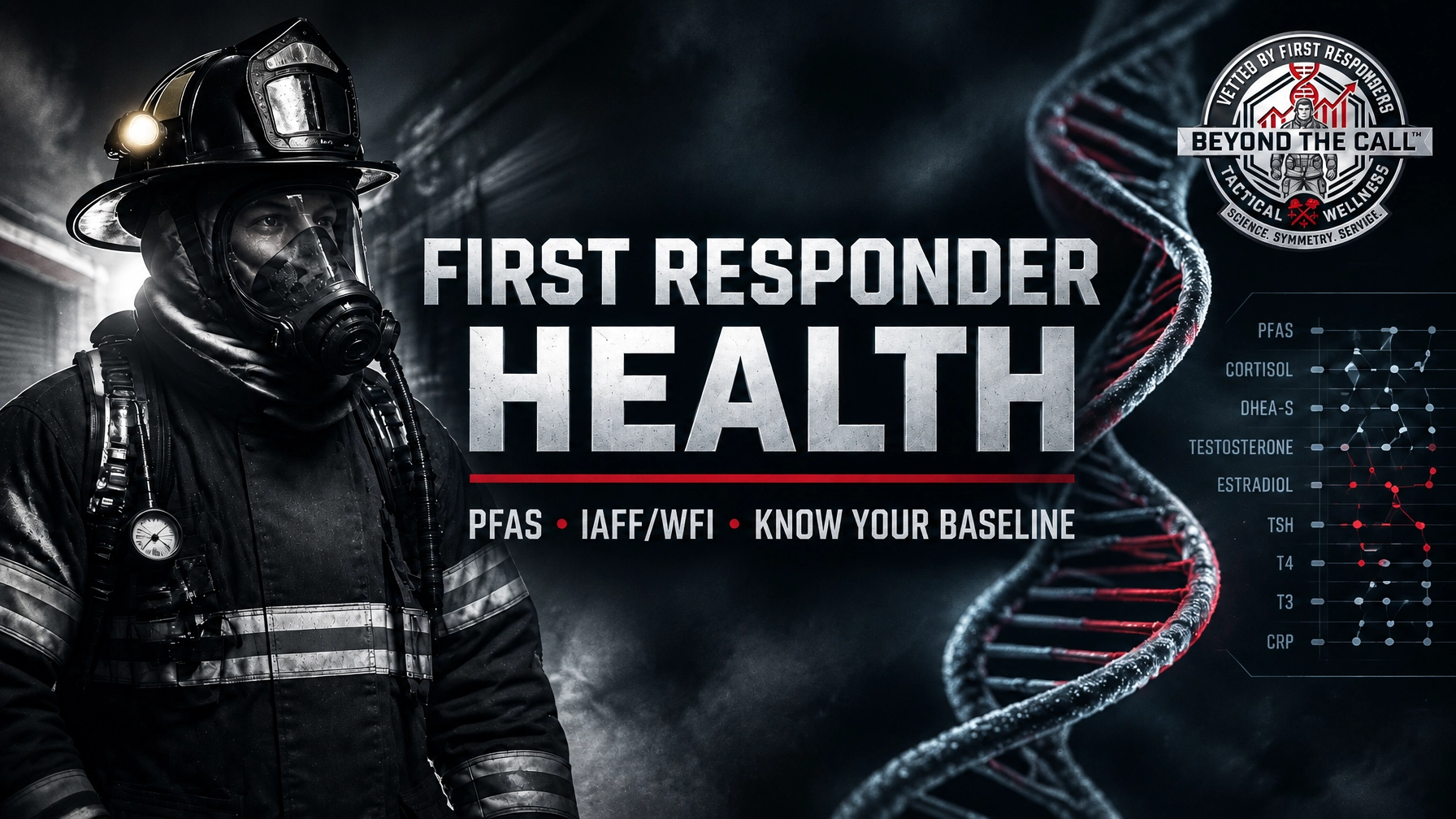

A fire department should not have to wait for an individual health crisis before starting a serious conversation about readiness.
The modern firefighter faces more than the immediate danger of an emergency call. Occupational exposures, shift work, heat, disrupted sleep, chronic stress, and repeated contact with smoke and combustion byproducts can create a long-term biological burden. Potential PFAS exposure may add another layer, particularly for responders who have worked with legacy AFFF foam, contaminated equipment, station dust, or older turnout gear.
This does not mean that exposure proves disease. It does not mean that every symptom is caused by PFAS. It does mean that departments have a responsibility to create a more informed health conversation.
At Body Symmetry MD Boston × Beyond The Call Health & Wellness, that conversation begins with a baseline.
For departments, readiness is not only about passing a physical. It is about understanding the health factors that support long-term service.
Standard vs. Proactive: Building on the IAFF/WFI Foundation
The IAFF/WFI wellness standard provides an important foundation for firefighter health, fitness, and professional readiness. Beyond The Call does not compete with, replace, criticize, or claim to improve upon that standard.
The opportunity is execution.
A standard establishes the framework. A proactive program helps departments and individual responders take data-driven action through:
- Department education and outreach
- Voluntary, confidential individual engagement
- Clinically appropriate bloodwork
- A 50+ Biomarker Audit
- Gold Key Bio-Blueprint reporting
- InBody body-composition tracking
- Licensed-provider review and follow-up
- Trend monitoring over time
This is not a recommendation that every responder needs every test. It is a structured way to identify which questions should be asked and which clinical evaluations may be appropriate.
A routine department physical may confirm that a responder is within a broad reference range. That is useful, but it is not the same as establishing a detailed personal baseline. A baseline creates a point of comparison for future decisions.
Why PFAS and AFFF Exposure Belong in the Conversation
PFAS, or per- and polyfluoroalkyl substances, are a large group of persistent chemicals used in many industrial and consumer applications. Certain legacy firefighting foams, including some AFFF formulations, contained PFAS.
Possible occupational exposure pathways for firefighters may include:
- Historical AFFF use during training or emergency response
- Contact with contaminated equipment or surfaces
- PFAS-treated turnout gear and related materials
- Off-gassing from gear stored in enclosed areas
- Station dust and contaminated workspaces
- Smoke and combustion byproducts
- Inadequate separation between contaminated and clean areas
- Repeated exposure over a long career
The science is still developing, but the reason for attention is clear: some PFAS can remain in the body for extended periods, and blood levels reflect accumulated exposure from multiple sources over time.
A PFAS blood test is not a cancer test. It does not diagnose cancer, infertility, or another disease. It cannot identify exactly where exposure occurred, when it happened, or whether a specific health condition was caused by PFAS. It also does not guarantee any future outcome.
Testing decisions should be made with a licensed clinician who can consider occupational history, symptoms, medical history, other exposures, and the purpose of testing.

What the Research Shows: and What It Does Not
The International Agency for Research on Cancer classified occupational exposure as a firefighter as Group 1, carcinogenic to humans, in 2022. This classification reflects evidence about firefighting as an occupational exposure category. It is not an individual diagnosis, and it does not prove that a specific responder’s illness was caused by firefighting.
The IARC evaluation considered the broader occupational environment, including multiple hazards associated with firefighting. PFAS are only one part of that larger exposure picture.
A 2021 peer-reviewed study published in the International Journal of Environmental Research and Public Health reported that certain PFAS serum levels in a suburban volunteer fire department population were up to 53% higher than the general U.S. population, with associations involving years of service and AFFF use. This was population-level observational evidence. It does not establish individual causation.
The 2021 study supports the value of continued research and careful occupational-health planning. It does not establish a universal clinical threshold or mean that every firefighter has the same level of risk.
NIOSH pooled-cohort research involving nearly 30,000 career firefighters reported a 9% increase in cancer diagnoses and 14% greater cancer mortality compared with the general U.S. population. These are group-level findings, not a prediction for any individual firefighter. NIOSH’s research summary emphasizes the importance of prevention, exposure reduction, and continued research.
The IAFF has also highlighted the burden of occupational cancer in the fire service, reporting that 72% of IAFF line-of-duty deaths in 2023 were from occupational cancer. This information deserves respect and careful context. It is not a reason to create fear; it is a reason to improve education, prevention, screening conversations, and support. See the IAFF cancer awareness resources.
Additional background is available through the NIOSH PFAS Science Bulletin.
The 50+ Biomarker Audit Is Broader Than a PFAS Test
A PFAS result answers a narrow exposure-related question. A broader clinical baseline organizes a larger health conversation.
The 50+ Biomarker Audit, also called the Gold Key Bio-Blueprint, may include clinically appropriate assessments across areas such as:
- Metabolic health
- Blood sugar regulation
- Lipids and cardiovascular risk
- Liver and kidney function
- Thyroid health
- Inflammation
- Iron status and nutrient-related markers
- Hormone-related markers
- Other measures selected by the licensed clinician
The purpose is not to overwhelm a responder with data. The purpose is to place the data in context.
For example, a responder may report low energy, poor recovery, or difficulty maintaining body composition. Those symptoms may relate to sleep disruption, shift work, nutrition, stress physiology, metabolic health, medication effects, hormone status, or several factors at once. A three-marker panel may not identify the full picture.
That is the difference between a narrow result and a forensic health review.
The 50+ Biomarker Audit is not itself a PFAS test. PFAS-specific testing, if considered, requires separate clinical judgment. Comprehensive bloodwork is mandatory before any consideration of testosterone treatment.

Caption: A broader biomarker baseline helps organize the clinical questions that may influence readiness, recovery, and long-term health.
Alt text: Firefighter standing beside a clinician reviewing a biomarker baseline report with hormone, thyroid, metabolic, and inflammation markers.
A Practical Department Pathway
A department wellness program does not need to begin with a complicated rollout. It can begin with a structured conversation.
1. Leadership or the wellness committee starts the conversation
Fire chiefs, wellness committees, union representatives, occupational-health leaders, and training officers can introduce the topic without making medical promises.
The goal is education: what is known, what remains uncertain, and what resources are available.
2. The department reviews exposure and health history
Education may include AFFF history, gear practices, decontamination procedures, station conditions, smoke exposure, sleep disruption, heat load, and years of service.
This is not an investigation of individual fault. It is a way to identify relevant questions.
3. Individual engagement remains voluntary and confidential
Each responder decides whether to participate in a clinical conversation. Medical decisions should not be made collectively or based on a department-wide assumption.
Individual information should remain confidential and should not be shared with department leadership in identifiable form.
4. A clinician determines what baseline evaluation is appropriate
Some responders may benefit from a broader biomarker review. Others may need a focused evaluation, preventive screening, or referral to occupational medicine. PFAS testing is not automatically appropriate for everyone.
5. Results are reviewed and tracked over time
A baseline becomes more useful when it creates a reference point for future trend tracking. InBody measurements, clinically appropriate bloodwork, symptoms, sleep patterns, and recovery concerns may all contribute to a longer-term plan.
VO2 testing is coming soon and should not be represented as currently available.
6. Departments receive education without identifiable medical data
Departments can learn about exposure reduction, recovery, sleep, preventive health, and readiness without receiving individual laboratory results. This protects trust while allowing the organization to support a healthier culture.
Health Is the New Wealth: for the Department and the Responder
A firefighter is not only an employee. A responder is part of a crew, a family, a community, and often a second professional operation.
Many first responders are also business owners, executives, contractors, or department leaders. They manage two demanding portfolios: their service role and their company.
A biological crash can affect both.
Poor sleep, unresolved fatigue, metabolic friction, impaired recovery, or untreated health concerns may influence on-scene performance and in-office decision-making. For the Tactical CEO, professional sustainability requires protecting the person who carries both responsibilities.
After 14 years of answering emergency calls, Otto now works to protect the health, readiness, and future of the first responders who serve. Beyond The Call leads first-responder outreach and department engagement. Body Symmetry MD provides the clinical partnership and licensed-provider review, bringing 13 years of clinical excellence to a comprehensive wellness model.
The Body Symmetry MD Boston wellness center is located at 340 Maple Street, Suite 205, Marlborough, MA. Care is also available through the licensed 14-state telehealth network serving:
Colorado, Florida, Georgia, Louisiana, Massachusetts, Maryland, North Carolina, Ohio, Tennessee, Texas, Virginia, New York, Pennsylvania, and Washington, D.C.
Care is provided only where the appropriate licensed services are available.
Departments: Start the Conversation
A department does not need to wait for a crisis, a diagnosis, or a difficult personnel event before discussing baseline health.
Start with education. Build trust. Protect confidentiality. Let licensed clinicians determine what is clinically appropriate for each responder.
Text AUDIT to 508-377-3121 or visit bodysymmetrymd.com/boston to start a department wellness conversation.
Individual first responders may also request a confidential conversation and learn whether a clinician-reviewed baseline is appropriate for them.
Leave a Reply